Designing Trust Into High-Stakes Corporate Digital Money Flows
A design case study on enabling corporate clients to move, settle, and use digital assets
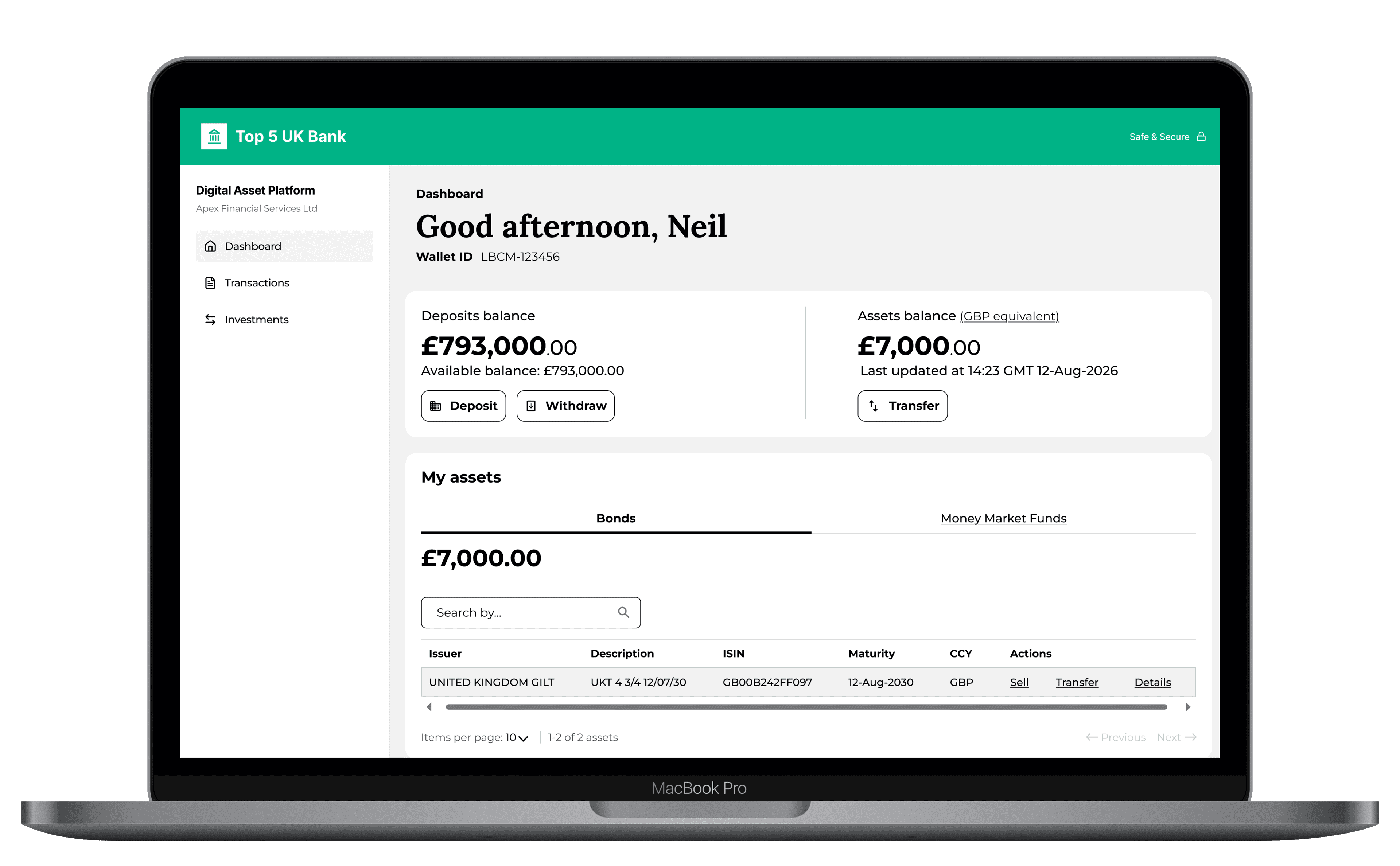
Disclaimer: The Work for this project is protected under NDA, so any visuals shown have been produced for illustrative purposes and are not the actual work produced
Rethinking Corporate Money Management
Moving and settling money is high-stakes for large corporate clients. These processes are cautious, tightly controlled, and deeply embedded within existing banking and trading systems, where accuracy and oversight matter.
By using blockchain infrastructure, digital assets can enable faster settlement, stronger auditability, and more direct asset exchange — reducing reliance on manual handoffs and fragmented systems.
But improved rails alone aren’t the only thing. Institutional banking clients still need to see what’s happening, and feel confident operating within workflows that involve approvals and audit checks.
This project explored how a digital asset platform could modernise corporate money flows without disrupting the control and governance clients rely on — introducing new technology whilst respecting established behaviours.
The Essentials
Designing for digital assets meant solving for two key challenges:
- Modernising corporate money flows
While the technology enables faster settlement, the real challenge was designing experiences that clients could trust and see value in. We needed to help users understand what was happening to their money, feel confident taking action, and reduce uncertainty in traditionally cautious, highly controlled workflows.
- Designing for an emerging technology
Digital assets are an emerging concept in the market and new to the bank. There were few familiar mental models or established design patterns, so we had to craft experiences that felt intuitive and trustworthy for clients navigating this unfamiliar territory.
My role
I acted as the lead product designer for key customer and colleague journeys, spanning wallet creation, deposits and withdrawals, asset discovery, trading, transfers, and approval flows.
Working within a cross-functional team, I collaborated closely with product owners, subject matter experts, front-and back-end developers, solution architects, researchers, and customer journey managers. I was responsible for setting design direction, validating decisions with product teams, and ensuring consistency and coherence across multiple feature teams.
In this case study, I focus on how design was used to make a complex, emerging capability understandable, trustworthy, and usable for corporate clients.
Getting started
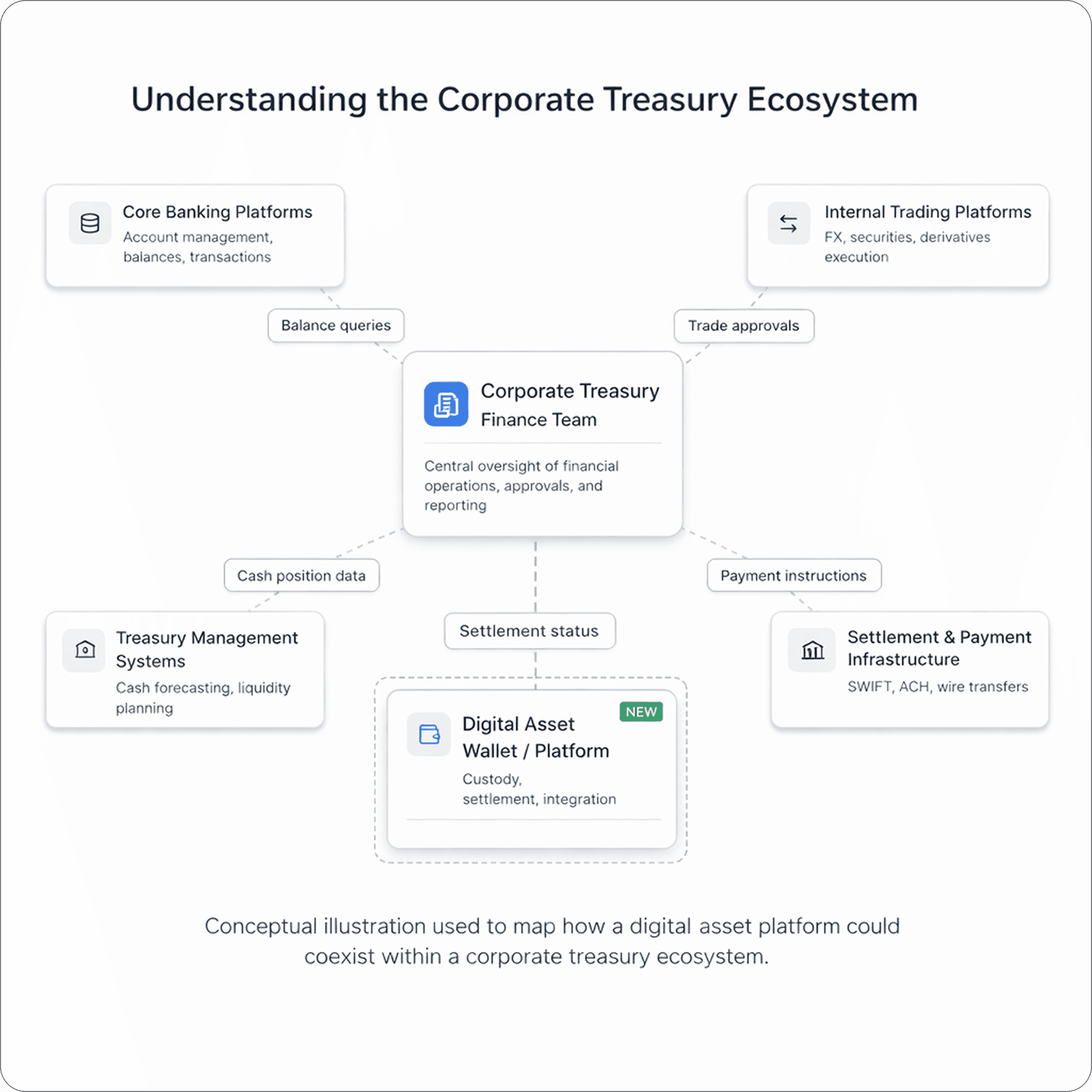
The Corporate Money Management ecosystem
For the banks large corporate clients, moving money is rarely a single action. It typically spans multiple settlement mechanisms, internal approvals, and coordination across banking, treasury, and trading environments. These layers exist to provide control and auditability, but they also introduce fragmentation, delays, and operational overhead.
In many cases, value can move technically faster than organisations are able to process, confirm, and reconcile it. Time is spent managing the mechanics of settlement rather than the intent of the transaction itself.
During early discovery, we stepped back to understand where this structural friction occurs and how a digital asset platform could change that model. Reviewing existing strategy work and workflows highlighted a consistent theme: clients weren’t looking for more tools, but for a way to reduce dependency on sequential systems while maintaining the governance they rely on.
Three themes emerged:
- Settlement processes are slowed by the need to bridge multiple platforms and controls.
- Operational effort is concentrated on coordination and reconciliation rather than value movement.
- Any new capability must preserve oversight and auditability, even as it simplifies execution.
Working closely with the product manager, we translated these observations into future-facing needs that shaped the design direction:
- As a Cash Manager, I need to move funds or assets knowing settlement will occur as agreed, without coordinating across intermediaries.
- As an Authorised Signatory, I need to approve transaction terms upfront, confident that execution will follow those rules automatically.
- As a Treasury or Risk lead, I need clear visibility and auditability of activity so control is maintained even as manual steps are reduced.
Competitor research insights
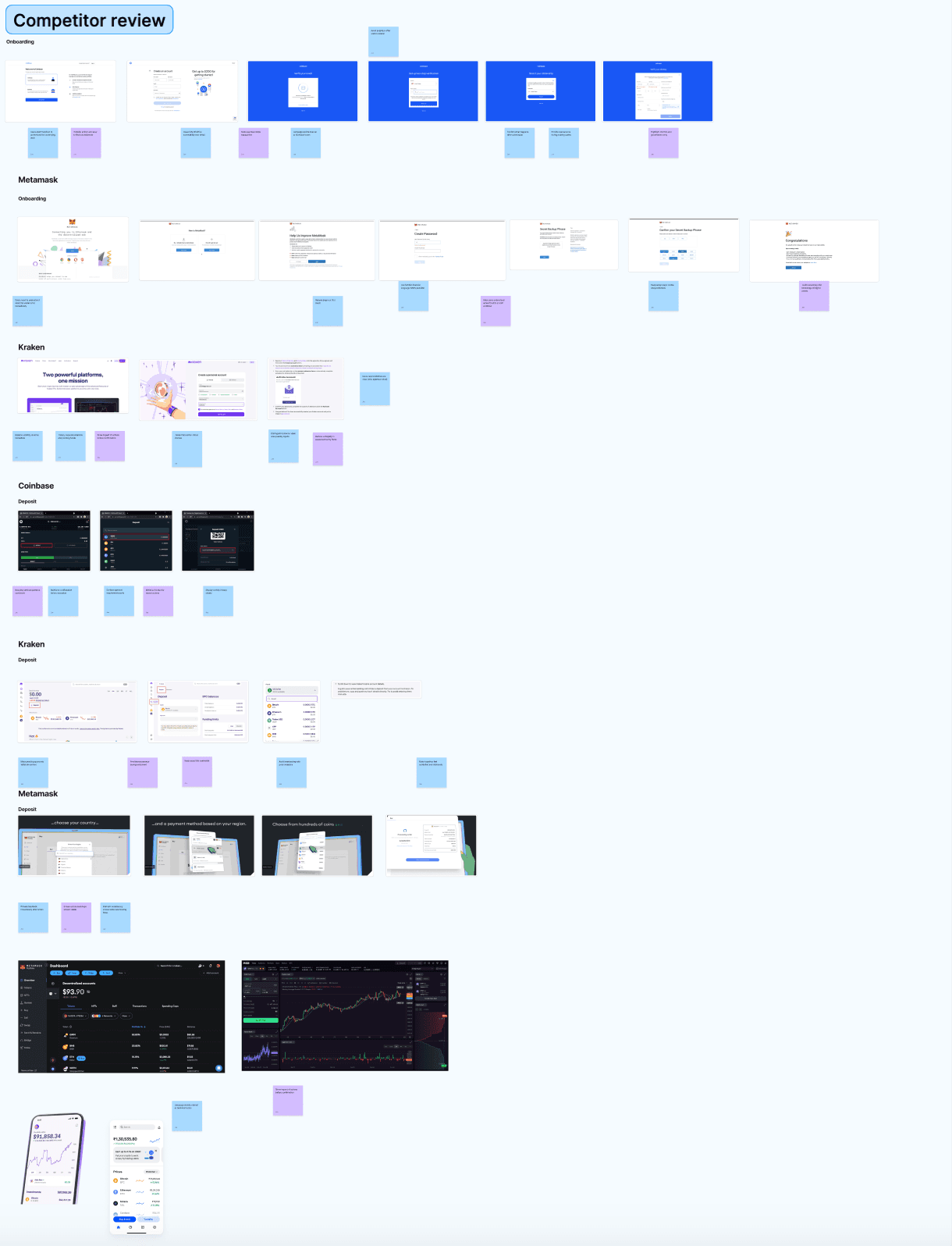
With a clearer view of the operational landscape, the next step was to understand how similar concepts are presented in practice — particularly in environments where digital assets are already being used. This helped us identify patterns we could learn from, while recognising that our platform would serve a different, more controlled context.
We reviewed a mix of external digital asset platforms and the client’s internal corporate banking products to understand how workflows and information are structured.
From this, we observed that:
- Terminology for digital assets varies widely across platforms.
- Navigation and interaction models differ depending on whether the product is public-facing or designed for institutional use.
- Certain approaches to structuring information helped make complex concepts easier to grasp.
These observations informed early design thinking and helped us shape a structure that felt familiar enough to navigate, while still aligned to corporate governance expectations, before moving into user testing.
The Solution
With this understanding, we moved into defining how these new capabilities would be expressed to users. The underlying blockchain enabled increased automation, and our role was to shape journeys that make those concepts clear and usable within familiar operational frameworks.
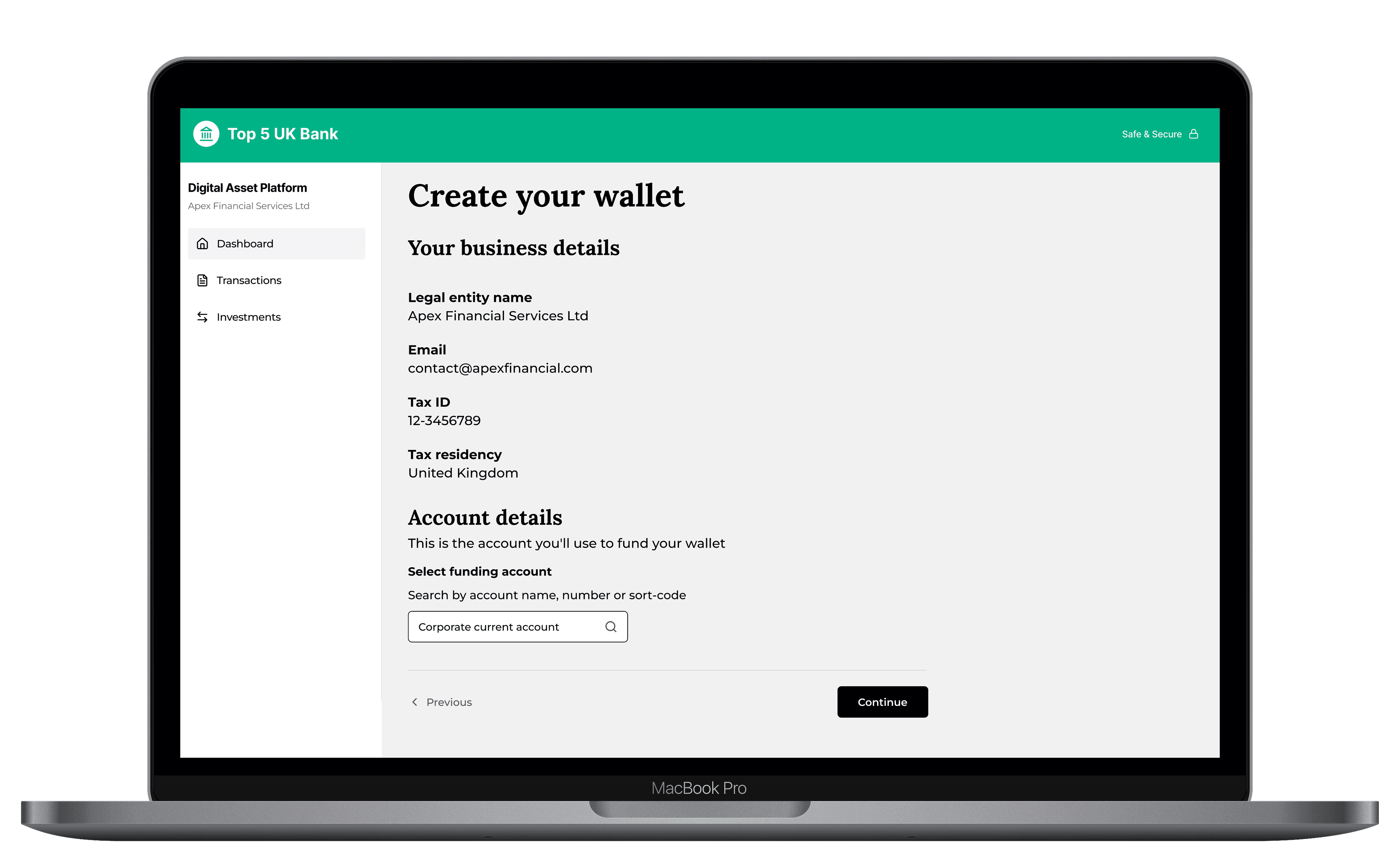
- Wallet Creation & Onboarding - A guided setup that introduces the wallet, explains what it’s used for, and sets expectations before any money is added.
- Adding Funds - A focused flow for moving money into the wallet, showing balance changes, pending activity, and approval status in real time.
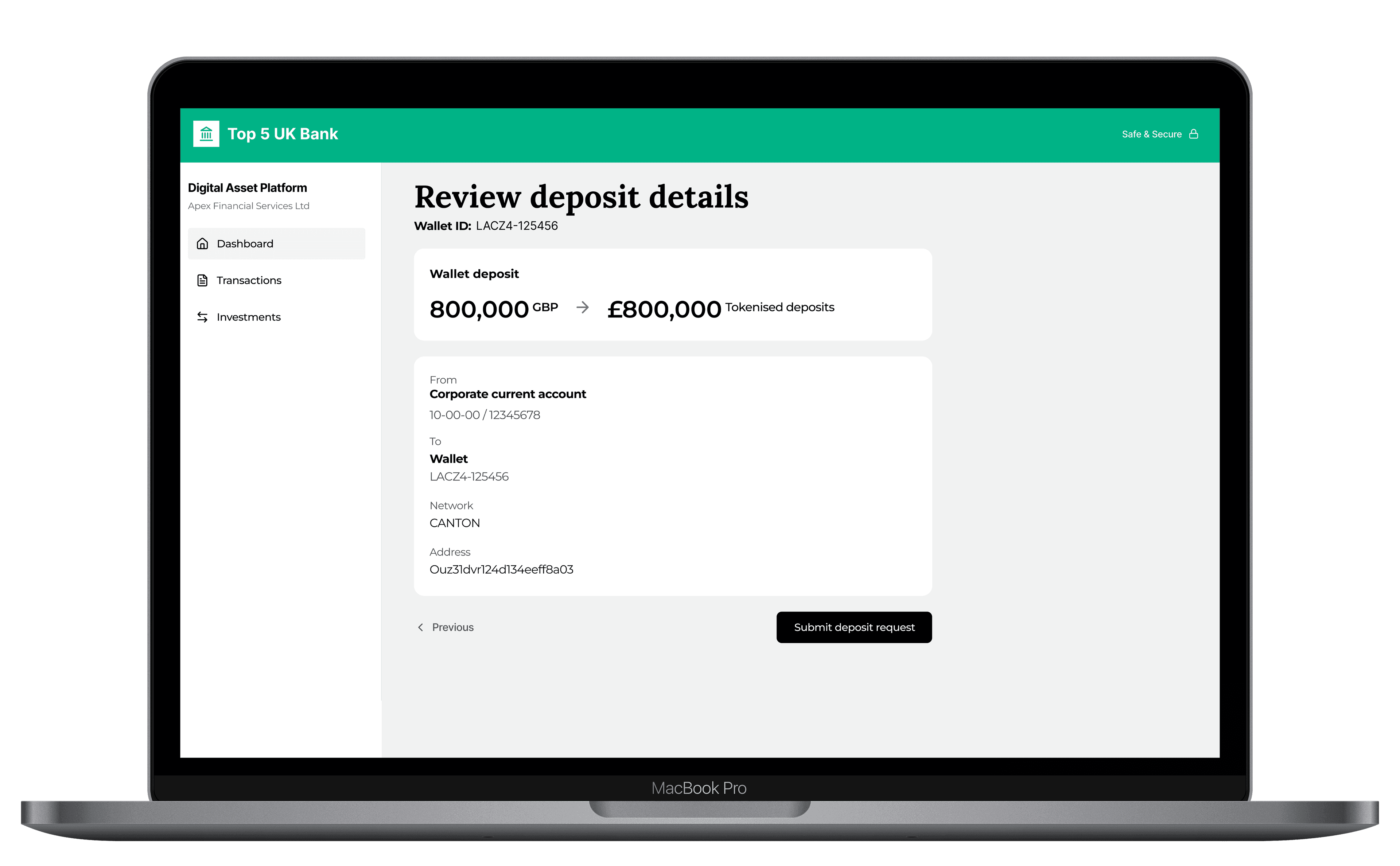
- Asset Discovery & Trading - Customers can browse available digital assets, choose units or amounts, and review purchases with clear information on price, total value, and asset type. Transactions are executed automatically via smart contracts for speed and reliability.
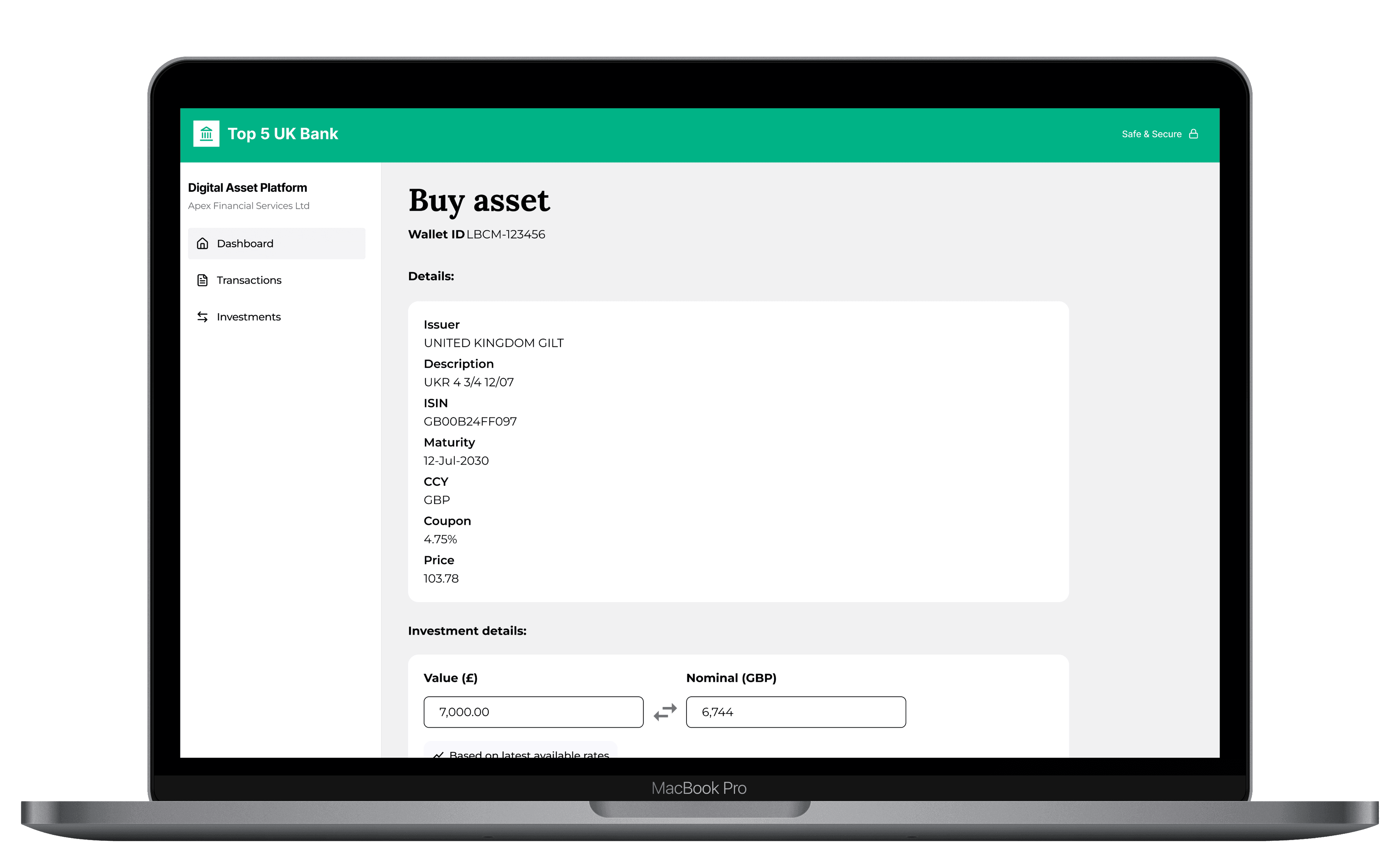
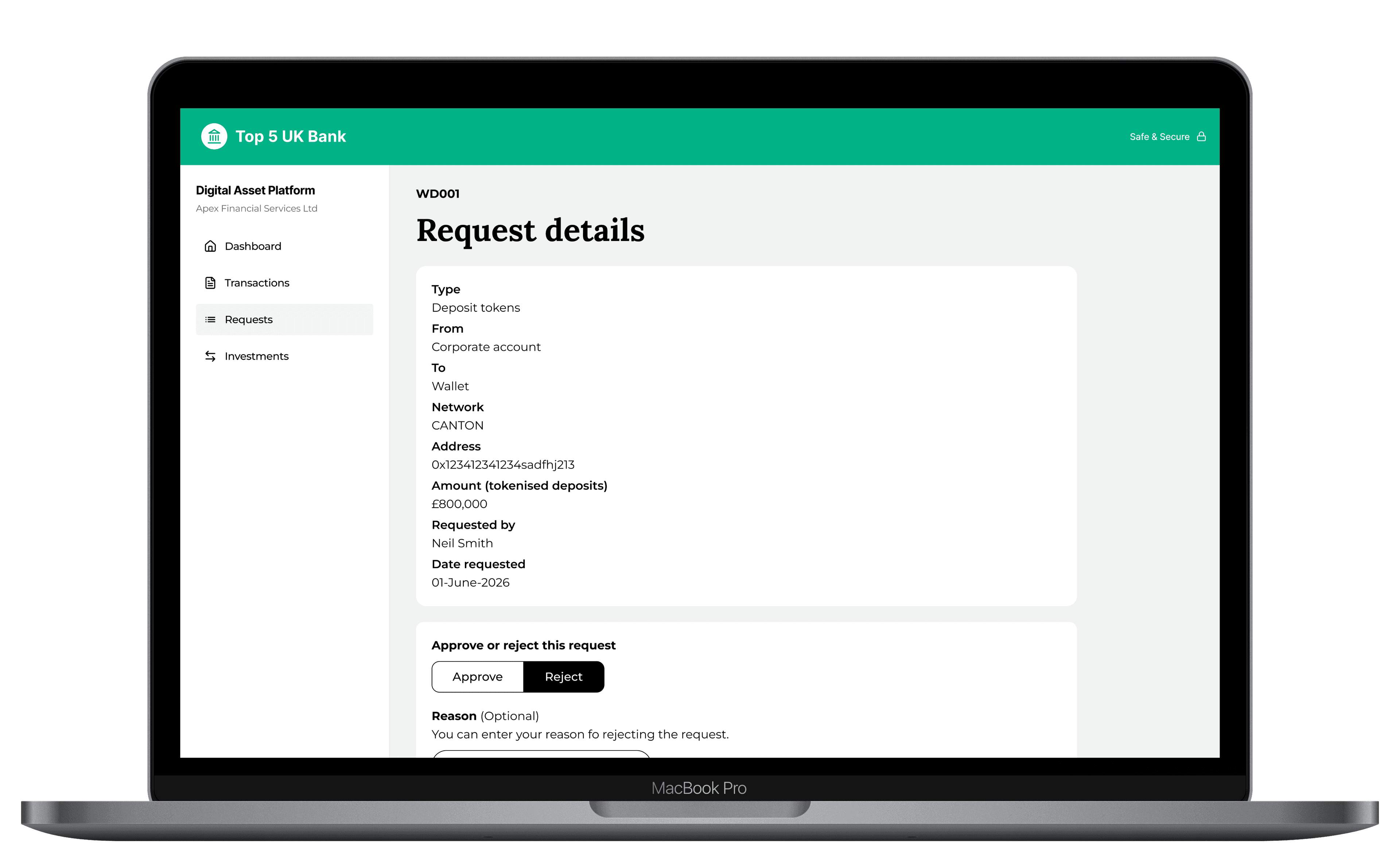
- Transfers & Approval Flows - Designed for operational efficiency, allowing approvals, rejections, and notifications, while automation through smart contracts reduces manual steps and keeps users confident in the process.
Testing our Assumptions
We worked with a researcher to test our early thinking with clients using a clickable prototype. Participants stepped through wallet setup, adding money, and purchasing assets to help us validate assumptions and understand how they interpreted the platform.
The sessions went beyond usability. We wanted to see how clients made sense of this new proposition. Many instinctively compared it to public crypto exchanges — often their only reference point — even though this platform sits closer to corporate banking and treasury workflows. That mismatch highlighted the need for clearer positioning and framing.
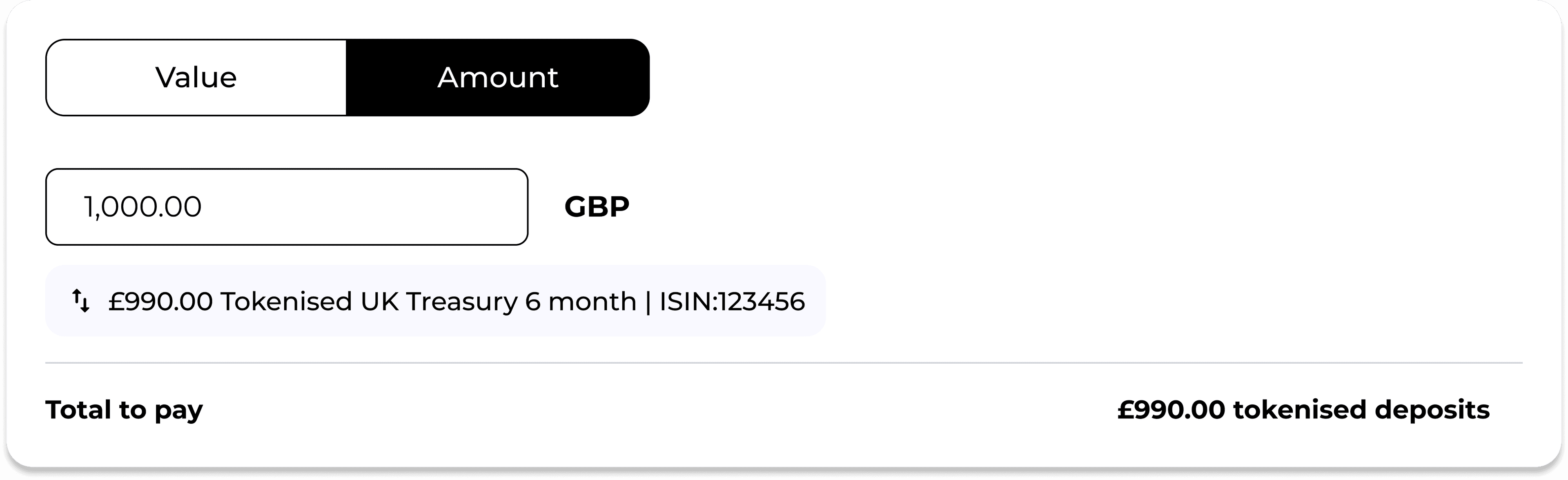
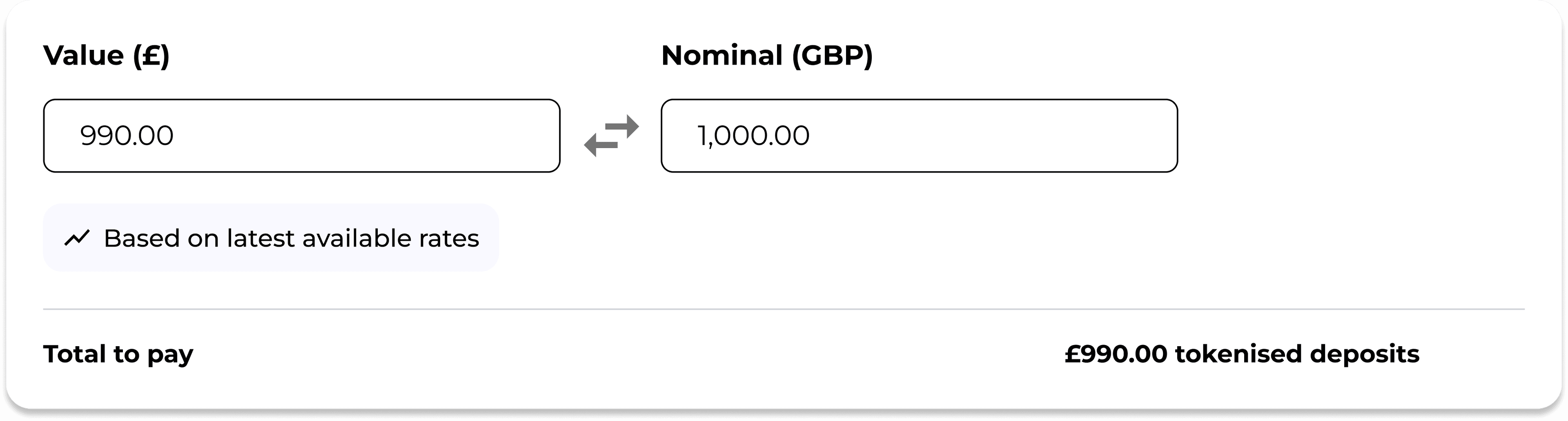
We also uncovered practical confusion. Some clients didn’t realise that adding money created a digital version of their funds. Others were unsure whether they were entering a monetary value or an asset quantity when investing.
These insights shaped how we refined language, clarified balances, and strengthened cues across key journeys.
Turning insight into action (opportunity mapping)
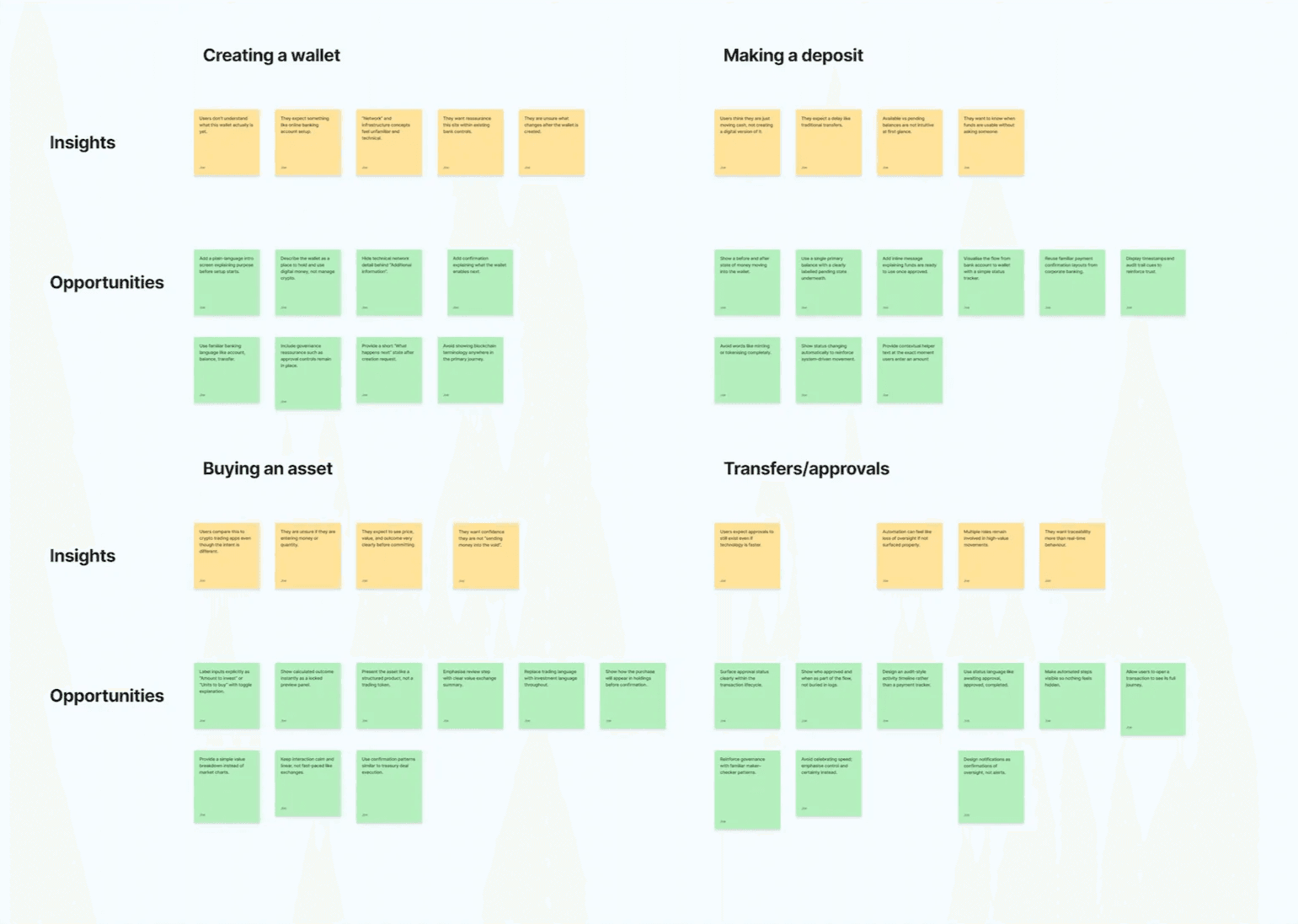
After running the research sessions, we held an opportunity mapping session to turn what we learned into clear, actionable design directions. The team reviewed feedback from the prototype walkthroughs and interviews, looking for areas where users struggled to understand how their money moved or interacted with digital assets.
From research to design decisions
Research and prototype walkthroughs highlighted where clients needed more confidence in how the platform behaved, particularly around how money appeared, how investments were entered, and how automated activity remained visible within existing control frameworks.
This led to several key design shifts:
- Remove ambiguity when investing
Inputs were redesigned to show both monetary value and asset quantity together, allowing users to see the relationship between the two. This mirrors familiar investment experiences and removes uncertainty about what they are committing to.
Before
After
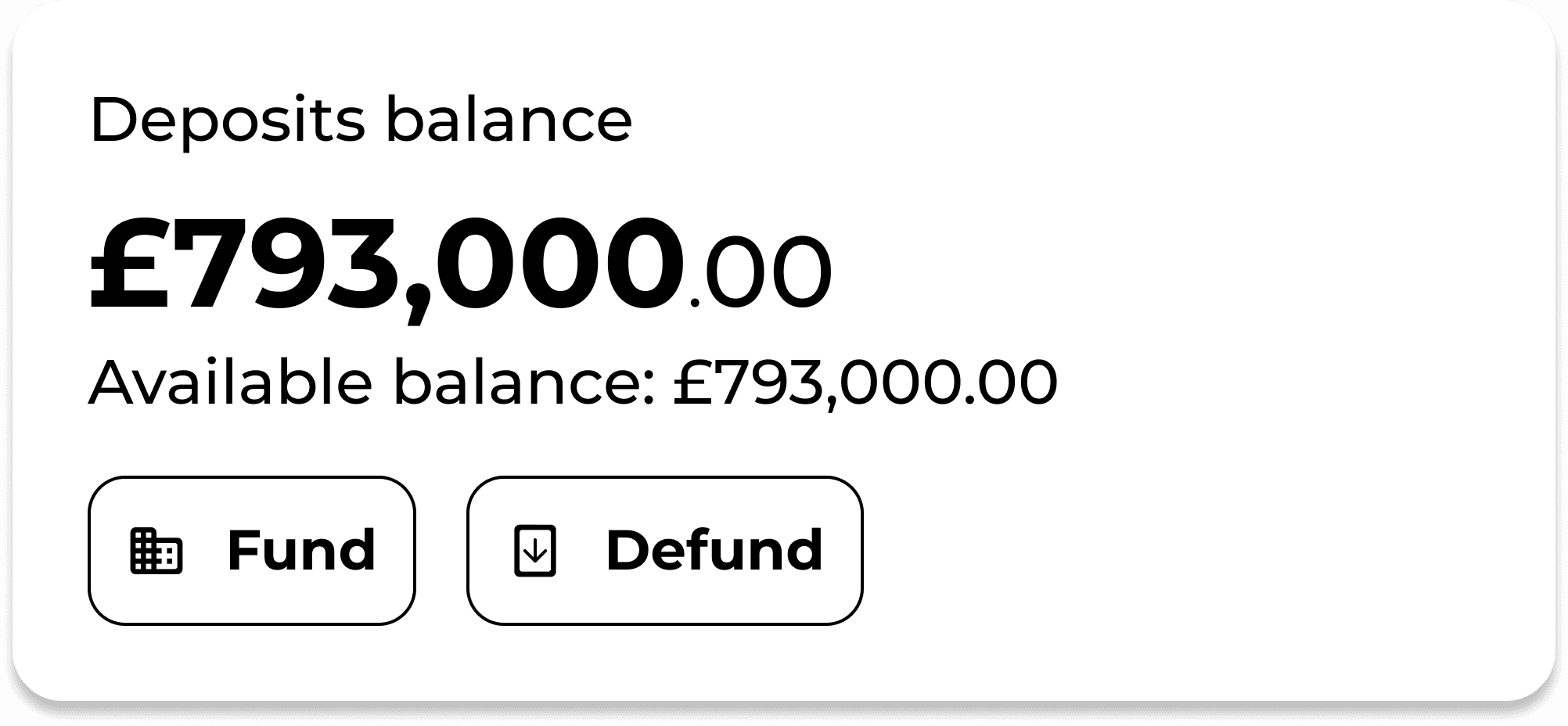
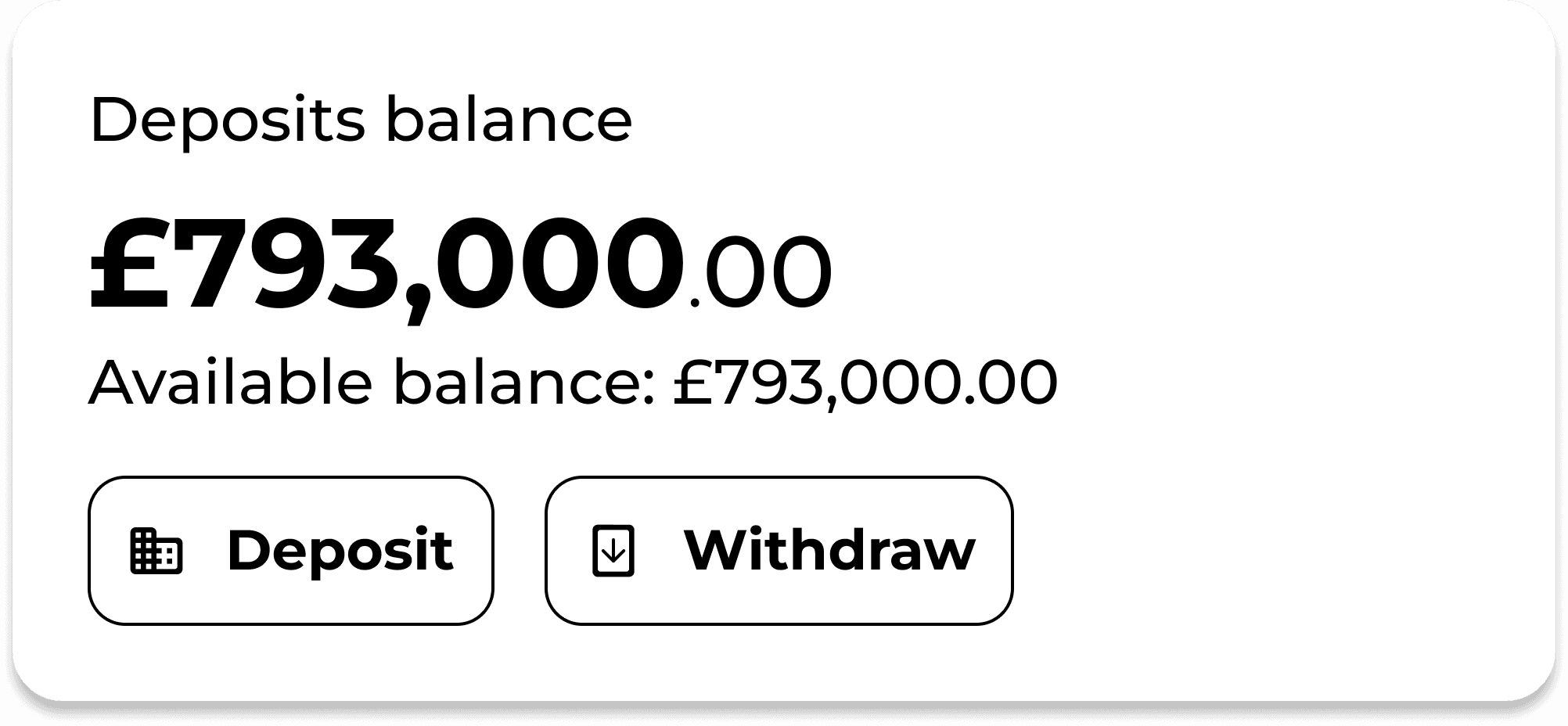
- Align to corporate, not retail, mental models
Internal blockchain terminology such as “mint,” “burn,” or “fund” was replaced with familiar financial language like “deposit” and “withdraw,” aligning the experience with corporate treasury workflows rather than retail crypto trading conventions.
Before
After
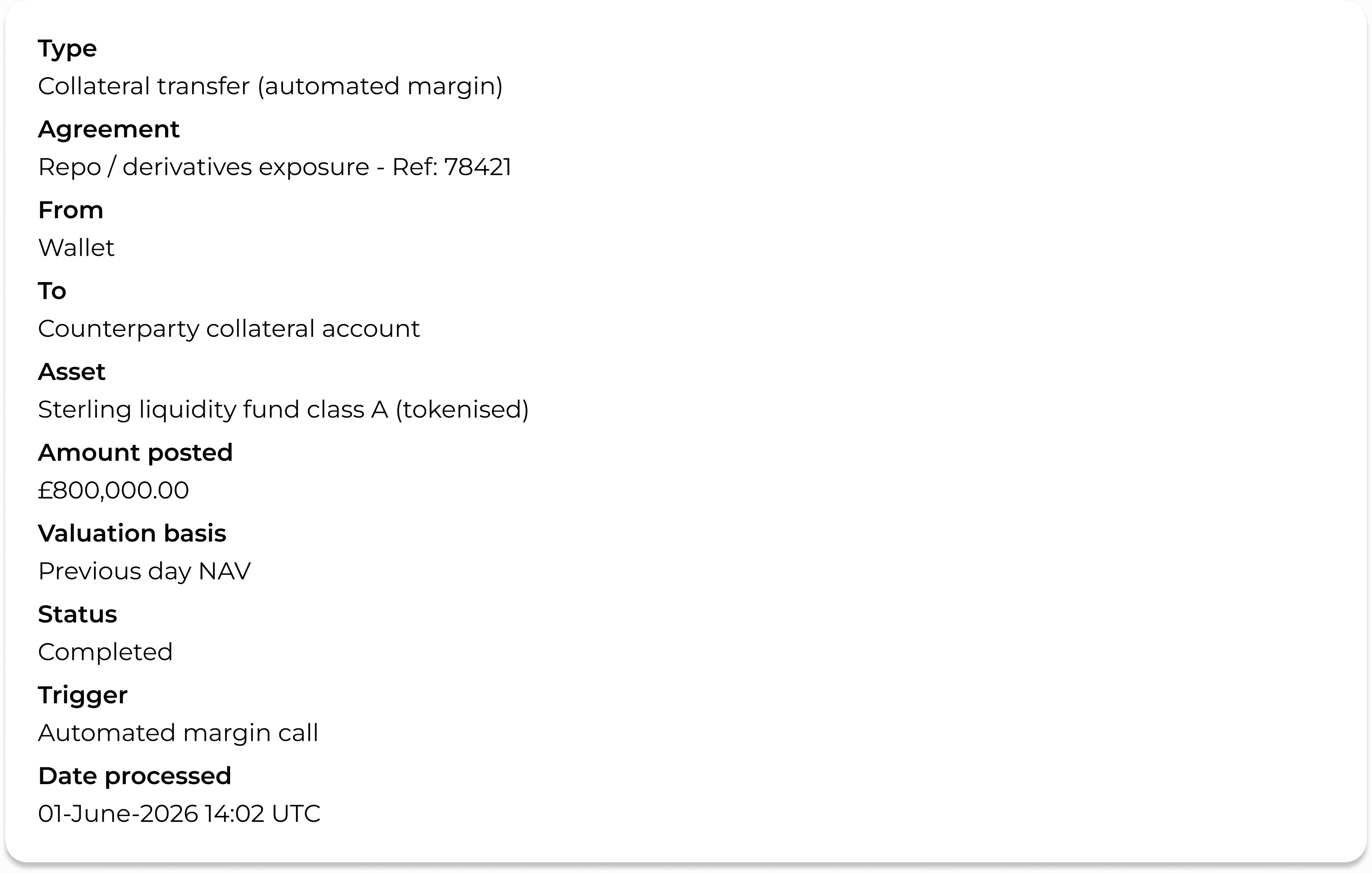
- Make system-driven activity feel accountable
Some actions are executed automatically, but clients still need to reconcile them within their own controls and reporting. We focused on showing clear records, timestamps, and references so automated events could be understood and verified as part of normal operational workflows.
Results & Outcomes
The experience developed through this project helped bring the proposition into practice, supporting a landmark pilot that connected tokenised deposits, digital assets, and traditional banking infrastructure in an end-to-end transaction.
Launch milestone
UK first
The UK's first public-blockchain transaction using tokenised deposits, and the world's first issuance of sterling tokenised deposits on a public blockchain.
Transaction outcome
Real-time
Tokenised deposits were used to purchase a tokenised UK government bond with instant settlement, reducing settlement and non-payment risk.
Proof of viability
End-to-end
Demonstrated that digital assets and traditional banking systems could work together smoothly within one end-to-end transaction.
Key Learnings & Looking Ahead
This work reinforced that introducing new infrastructure is only part of the challenge. Even when the underlying technology enables more direct and automated processes, organisations still need experiences that align with their existing governance, approval, and reporting models.
It also highlighted how few established interaction patterns exist in this space. Design decisions around language, structure, and flow played an important role in helping the platform feel credible and usable within a corporate environment.
Ultimately, the focus was less on explaining the technology and more on ensuring it could be adopted confidently for an institutional banking client.